Showing posts with label Science. Show all posts

Wednesday, September 26, 2012

Google Maps now in Underwater !

Underwater panoramas - Google Maps

Today google  add the first underwater panoramic view to Google Maps.   With these Extremely impressive photos anybody can walk through the ocean,  dive with shark and fish.


sea turtles at Heron Island, Great Barrier Reef


sea turtles at Heron Island, Great Barrier Reef
To see all Under water photos click here.


Wednesday, September 19, 2012

The world's most sensitive digital camera

The world's most sensitive digital camera  opens eyes into deep space, and the barred spiral galaxy NGC 1365 looks to be staring right back. Some 60 million light-years from Earth, NGC 1365 stars among the first pictures from the new 570-megapixel Dark Energy Camera, released Tuesday(Sept. 12, 2012).


Eight billion years ago, rays of light from distant galaxies began their long journey to Earth. That ancient starlight has now found its way to a mountaintop in Chile, where the newly-constructed Dark Energy Camera, the most powerful sky-mapping machine ever created, has captured and recorded it for the first time.
This high power Camera Built at the U.S. Department of Energy's Fermi National Accelerator Laboratory in Illinois, camera is now perched atop a Chilean mountain.


Photograph courtesy NOAO/NSF


The Dark Energy Survey is expected to begin in December, after the camera is fully tested, and will take advantage of the excellent atmospheric conditions in the Chilean Andes to deliver pictures with the sharpest resolution seen in such a wide-field astronomy survey. In just its first few nights of testing, the camera has already delivered images with excellent and nearly uniform spatial resolution.
Over five years, the survey will create detailed color images of one-eighth of the sky, or 5,000 square degrees, to discover and measure 300 million galaxies, 100,000 galaxy clusters and 4,000 supernovae.
A zoomed-in detail of an image from the Dark Energy Camera shows the barred spiral galaxy NGC 1365


Additional Information 

The Dark Energy Survey camera, DECam (Credit: Fermilab)

The science requirements of the Dark Energy Survey (DES) drive the construction of the Dark Energy Camera, DECam. DES will look deeply into the universe, observing galaxies at great distances to record their motion and conditions in the distant past. To do this, DES needs a camera which will view relatively large areas of the sky at once while being sensitive to the redshifted light from these distant objects. To accomplish this task, DES has designed a camera with five major systems:
  • a 570-megapixel CCD camera,
  • a low-noise electronic readout system,
  • a wide-field optical corrector,
  • a combination shutter-filter system, and
  • a hexapod adjustor to provide stability.
Just as DES is an international collaboration, DECam is an international camera with components built in five different countries.

The 570 megapixel CCD Camera

A prototype of the Dark Energy Survey camera, DECam. The front ring holds the detecting CCDs and is 45cm in diameter. (Credit: Fermilab)

In order to complete its science goals, DES will use CCDs that engineers at Lawrence Berkeley National Laboratory (LBNL) specifically designed to observe red light from distant galaxies. For example, the chance of detecting long-wavelength light is increased when it travels through more silicon, so DES CCDs are about 10 times thicker than conventional CCDs.
The DECam focal plane will consist of a science array of sixty-two 2048 X 4096 CCDs. Additionally there are four 2048 X 2048 guider CCDs and eight 2048 X 2048 focus and alignment CCDs. The quantum efficiency of these LBNL-designed CCDs with their anti-reflective coating is red optimized to be > 90% at 900nm and over 60% over the range of 400-1000nm. The DES CCDs are fabricated by Dalsa with further processing done by LBNL. They are packaged and tested by Fermilab.
DECam will operate at -100oC in order to minimize noise and dark current with the cooling provided by liquid nitrogen. To prevent condensation on the surface of the CCDs, DECam will operate at that the extremely low vacuum pressure of 10-6 Torr.

The Low Noise Readout System

The electronics will allow an entire digital image to be read out and recorded in 17 seconds, a very short period for an image of this size. This will allow the camera to be read out in the time it takes the telescope to move to its next viewing position. The noise of the readout system will be so low that while an image may produce a full-well specification of 130,000 electrons there will be less than 25 electrons of noise in each pixel. The electronics will record the data in the form of a mulit-extension fits (MEF) file and will also provide real-time instrument health and quality checks.

The Wide Field Optical Corrector


The optical corrector system is a Wynne-style five lens, two asphere design. It provides a 2.2 degree field of view image at 0.27"/pixel while contributing less than 0.3" FWHM to the image quality. The lenses have been cast by Corning in New York and are being polished by SESO in France. The biggest of these lenses will be 98 cm in diameter and will weigh 380 pounds.

The Combination Shutter-Filter System


The cartridge-style filter changer holds up to eight filters, which, at 62cm in diameter, are the largest produced. DES will use five filters, which astronomers have designated g, r, i, z, and Y. Each will let through a relatively broad spectrum of colors, such as red light, green light, or blue light. By comparing the relative amount of light detected through each filter for each object in an image, astronomers can make a very good estimate of the redshift of each object. (For more information on the meaning of a galaxy's redshift and how DES will estimate it for each galaxy.)
These filters are being manufactured by Asahi Spectra, headquartered in Tokyo Japan. The shutter, manufactured at Bonn University in Germany, is the largest shutter of its kind. The filter changer was manufactured at the University of Michigan.

Hexapod Adjustors

The hexapods provide a real-time focus and alignment system to maintain high image quality. They are being manufactured by ADS International in Leco, Italy.

For more about vist www.darkenergysurvey.org


courtesy www.darkenergysurvey.org, www.fnal.gov, www.noao.edu.


Monday, September 17, 2012

india based neutrino observatory - Kerala Tamilnadu border to have one of the worlds biggest underground laboratory.

India-based Neutrino Observatory


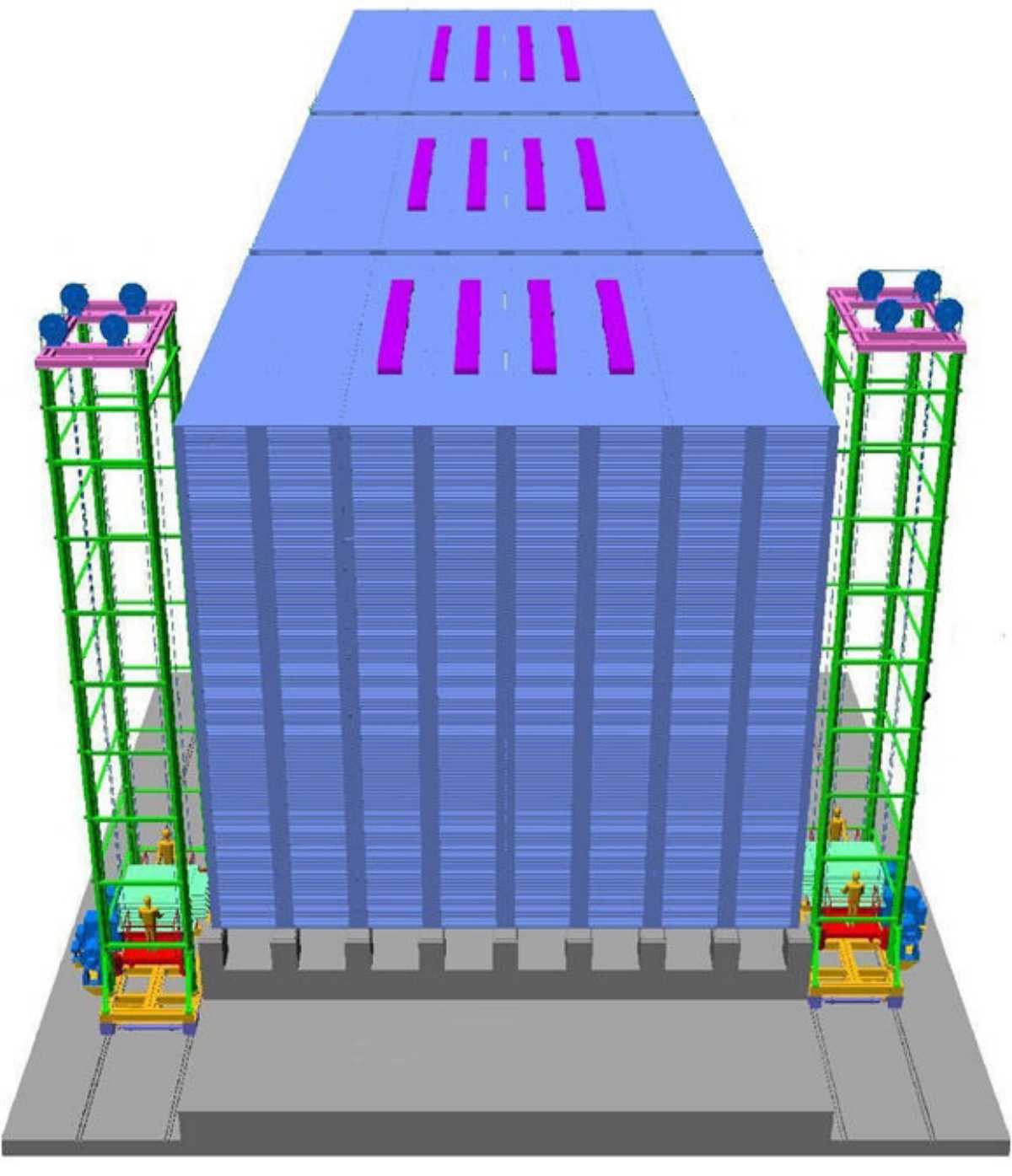
             INO is a multi-institutional collaboration which aims to build an underground laboratory for pure Science research, especially in Neutrino Physics. The project includes construction of an iron calorimeter detector, called ICAL, that will be the world's most massive detector when completed. ICAL at INO holds the key to understanding several fundamental issues regarding the nature and interactions of neutrinos.The world's biggest electro-magnet could come up at the proposed Rs.900-crore India-based Neutrino Observatory (INO) Project in Theni district, if the project is implemented expeditiously, according to G. Rajasekaran, Adjunct Professor, Institute of Mathematical Sciences, Chennai,The institute, which is involved in research of neutrinos, is working in site-related activities of the INO.


INO Diagram
Addressing a National Science Mela on ‘Science and philosophy of biodiversity' organised at Arul Anandar College in Karumathur, near here, on Wednesday, he said that the 50,000-tonne magnetic detector would be constructed inside a cavern that would be located in a one to three-km tunnel dug from the peak of the hill. The proposed project could also become the first to detect both neutrinos and anti-neutrinos separately.


Kerala- Tamilnadu border Village-Theni-Pottipuram- Ambarasan Hill


Larger than LHC 

The project, expected to be completed in 2015 at an estimated cost of $250 million, has been cleared by the Ministry of Environment (India) for construction in the Bodi West Hills Reserved Forest in the Theni district of Tamil Nadu. When completed, the INO will house the world's most massive magnet, four times larger than the 12,500-tonne magnet in the Compact Muon Solenoid detector at CERN in Geneva, Switzerland.When completing INO it will  help answer some of the fundamental open questions in physics.


The project includes

(a) construction of an underground laboratory and associated surface facilities at Pottipuram in Bodi West hills of Theni District of Tamil Nadu,
(b) construction of a Iron Calorimeter (ICAL) detector for studding neutrinos, consisting of 50000 tons of magnetized iron plates arranged in stacks with gaps in between where Resistive Plate Chambers (RPCs) would be inserted as active detectors, the total number of 2m X 2m RPCs being around 29000, and
(c) setting up of National Centre for High Energy Physics at Madurai, for the operation and maintenance of the underground laboratory, human resource development and detector R&D along with its applications. The underground laboratory, consisting of a large cavern of size 132m X 26m X 20m and several smaller caverns, will be accessed by a 2100 m long and 7.5 m wide tunnel.


The initial goal of INO is to study neutrinos. Neutrinos are fundamental particles belonging to the lepton family. They come in three flavours, one associated with electrons and the others with their heavier cousins the muon and the Tau. According to standard model of particle physics, they are mass less. However recent experiments indicate that these charge-neutral fundamental particles, have finite but small mass which is unknown. They oscillate between flavours as they propagate. Determination of neutrino masses and mixing parameters is one of the most important open problems in physics today. The ICAL detector is designed to address some of these key open problems in a unique way. Over the years this underground facility is expected to develop into a full-fledged underground science laboratory for other studies in physics, biology, geology, hydrology etc.


Participating Institutes

Memorandum of Understanding (MoU) spelling out the operational aspects of the project and the mode of utilisation of available funds was signed by seven primary project partners:Tata Institute of Fundamental Research (TIFR), Mumbai, Bhabha Atomic Research Centre (BARC), Mumbai, Institute of Mathematical Sciences (IMSc), Chennai, Saha Institute of Nuclear Physics (SINP), Kolkata, Variable Energy Cyclotron Centre (VECC), Kolkata, Harish Chandra Research Institute (HRI), Allahabad and Institute of Physics (IOP), Bhubaneswar.[1]
Thirteen other project participants include: Aligarh University, Aligarh, Banaras Hindu University, Varanasi, Calcutta University (CU), Kolkata, Delhi University (DU), Delhi, University of Hawaii (UHW), Hawaii, Himachal Pradesh University (HPU), Shimla, Indian Institute of Technology, Bombay (IITB), Mumbai, Indira Gandhi Centre for Atomic Research (IGCAR), Kalpakkam, North Bengal University (NBU), Siliguri, Panjab University (PU), Chandigarh, Physical Research Laboratory(PRL), Ahmedabad, Sálim Ali Centre for Ornithology and Natural History (SACON), Tamil Nadu and Sikkim Manipal Institute of Technology, Sikkim.


courtesy:wikipedia.org , www.ino.tifr.res.in/ino  , http://www.hindu.com